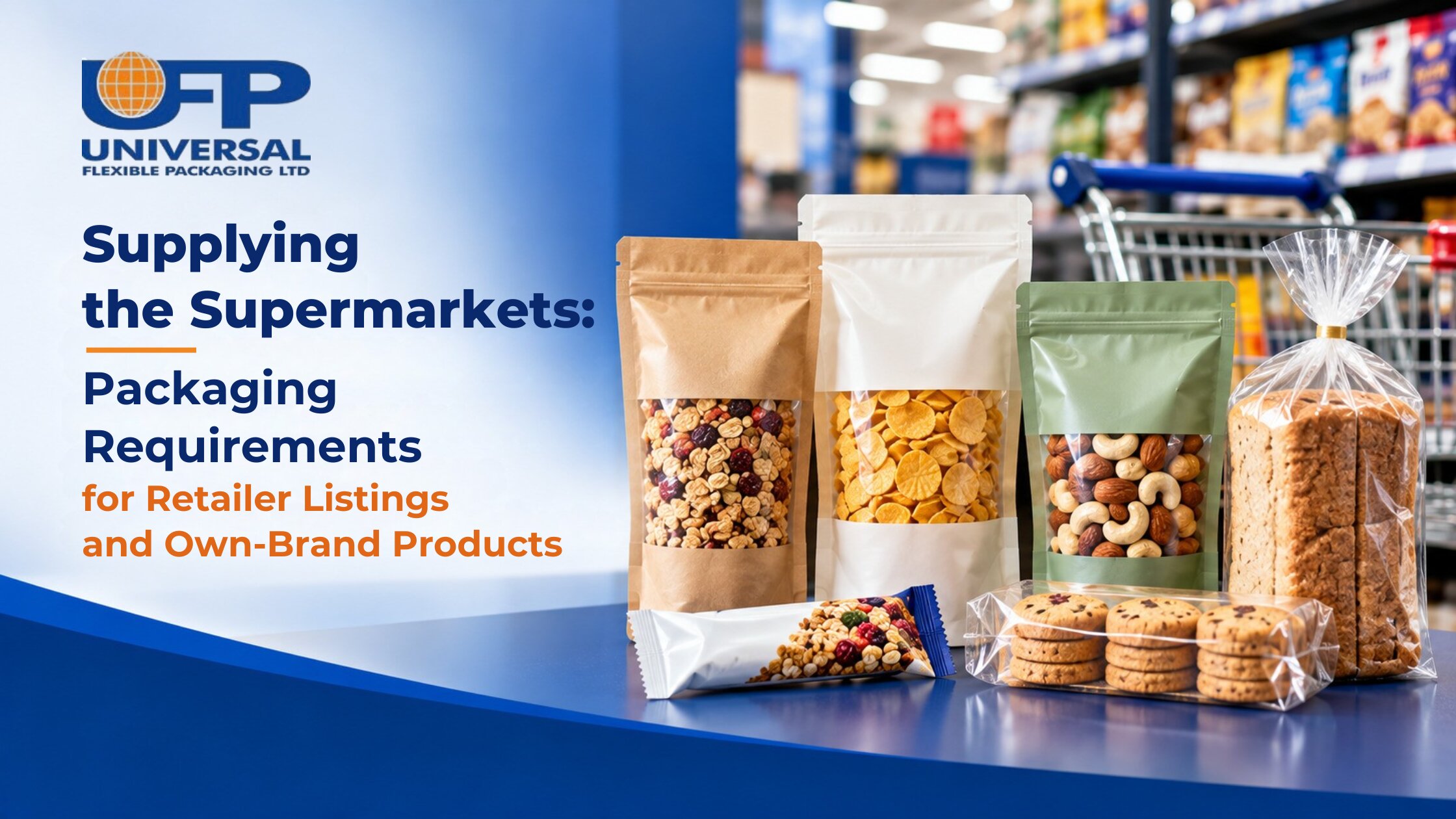
Before a food product reaches a supermarket shelf, its packaging may need to pass a series of technical and commercial approvals. Retailers can request food-contact documentation, packaging specifications, traceability records and evidence of relevant supplier certification.
Own-brand projects often involve additional controls over materials, printed artwork and changes to an approved pack. Food brands need to understand these requirements before confirming the packaging specification or production schedule.
UK supermarkets typically expect food packaging to meet applicable food-contact and labelling laws, with suitable quality controls, traceability and documented packaging specifications. Depending on the retailer and product, suppliers may also need recognised certification such as BRCGS, packaging performance evidence, GS1-compatible barcodes and approval of the final printed pack. Own-brand products often have additional retailer-controlled specifications covering materials, design and production changes. The exact requirements must be confirmed with the supermarket.
What packaging standards do UK supermarkets require from suppliers?
Food brands supplying supermarkets need to meet the packaging and labelling laws applicable to their products.
Individual retailers can also impose technical specifications, certification requirements and approval procedures through their supplier agreements.
Packaging manufacturers, food producers and brand owners may each be responsible for different parts of the approval process.
Common areas of assessment include:
- Compliance with applicable food-contact material regulations
- Food safety and quality management systems
- Relevant third-party certification or supplier audits
- Traceability of packaging materials and finished batches
- Approved packaging specifications
- Accuracy of printed product information
- Barcode identification and scanning performance
- Packaging strength and sealing integrity
- Environmental and recyclability information
- Compliance with the retailer's own technical standards
For flexible packaging, a retailer or food manufacturer may request technical specifications, food-contact compliance documentation and evidence of relevant performance testing.
Packaging for products stored at ambient temperatures can have different performance requirements from packaging intended for chilled or frozen distribution.
The documentation required should reflect the product, material structure and agreed conditions of use.
Why is BRCGS certification important for supermarket packaging?
BRCGS certification is widely recognised across the food and packaging supply chain.
It provides an independent framework for assessing relevant product safety, quality management and operational controls.
The BRCGS Global Standard Packaging Materials addresses areas including product safety, legality, quality, hygiene, supplier management and traceability.
Certification involves an independent assessment of the site's systems and practices against the applicable standard.
Retailers and food brands can use recognised certification schemes when evaluating suppliers and managing risks within their supply chains.
Which BRCGS standard applies?
BRCGS Packaging Materials provides a recognised certification framework for packaging operations, covering product safety, quality, hygiene, traceability and management controls.
Food manufacturers and contract packers may require certification against different standards, depending on their activities.
Retailers can specify which schemes, certification grades and audit arrangements they accept as part of supplier approval.
BRCGS certification is not a universal legal requirement for every company supplying a UK supermarket.
The relevant standards should be confirmed for the packaging manufacturer and any separate food manufacturing or contract packing operation involved in the project.
What food safety and traceability requirements apply to retail packaging?
Food-contact packaging needs to comply with the regulations that apply to the product and market in which it will be sold.
The selected materials must be suitable for their intended use and must not transfer substances to food in amounts that compromise safety or otherwise breach applicable requirements.
The required evidence depends on the packaging material and how it will be used.
For certain food-contact materials, including plastics, businesses must maintain appropriate documentation demonstrating compliance with the relevant rules.
Food brands may need to obtain supporting documentation from their packaging supplier as part of the retailer approval process.
Packaging traceability
Traceability allows businesses to identify the materials and production batches associated with a particular packaging order.
This is important when investigating quality problems or identifying affected packaging following a complaint or potential safety issue.
A traceability system can include:
- Identification of raw material suppliers
- Records of relevant film and material batches
- Production and conversion records
- Identification of finished packaging batches
- Records of quality inspections
- Information linking finished packaging to customer deliveries
Food manufacturers should also maintain suitable records linking packaging batches to their own production runs.
This helps identify potentially affected finished products if a packaging defect, incorrect printed information or material issue is discovered.
Quality and performance checks
Retail packaging may also need testing appropriate to its intended use.
For flexible packaging, this can include assessing seal performance, film strength and other properties relevant to the product.
Packaging for foods sensitive to moisture or oxygen may require additional consideration of barrier performance.
The technical specification should reflect the actual food product and its intended storage and distribution conditions.
What are the packaging and labelling requirements for supermarket products?
Retail packaging needs to carry the information required by food labelling legislation and meet any additional requirements agreed with the retailer.
For prepacked food, applicable information can include:
- The name of the food
- An ingredients list
- Allergen information
- Net quantity
- Date marking, where required
- Batch or lot identification, subject to applicable requirements and exemptions
- Storage conditions and instructions, where applicable
- The name and address of the responsible food business
- Nutrition information, where required
- Other product-specific mandatory declarations
The business responsible for the food must confirm which information is required for the particular product and market.
Mandatory food information must remain legible on the finished pack.
Businesses need to account for the minimum text-size rules, the available printable area and any folds or seals that could obscure information.
Under the applicable general food information rules, mandatory particulars generally require a minimum x-height of 1.2 mm, with a 0.9 mm allowance for certain smaller packages.
Barcodes and product identification
Supermarkets use barcodes to identify products at checkout and throughout their distribution operations.
GS1 standards provide a recognised system for allocating product identification numbers and preparing barcodes.
Retail products commonly use EAN-13 barcodes, while cases and other distribution units can require different identification and barcode arrangements.
Food brands should confirm the relevant GTIN and barcode requirements before final artwork approval.
Environmental and recycling information
Supermarkets may request packaging material composition, component weights and recyclability information as part of their environmental specifications.
Under the UK's packaging Extended Producer Responsibility framework, obligated businesses have reporting duties that depend on their size, activities and the packaging they supply.
Large producers subject to the relevant requirements must also assess the recyclability of applicable packaging using the government's Recyclability Assessment Methodology.
Retailer information requests and statutory EPR obligations should be considered separately.
The recyclability assessments used for EPR reporting are also distinct from consumer-facing recycling labels.
Environmental claims printed on packaging should be supported by appropriate evidence and comply with the applicable rules.
How do packaging specifications differ for supermarket own-brand products?
Own-brand products are developed and supplied under a retailer's brand, giving the retailer direct involvement in the presentation and specification of the finished pack.
A retailer may provide detailed requirements covering packaging format, material construction, dimensions, graphics and technical performance.
These requirements are often managed through formal specifications and approval procedures.
For flexible packaging, an own-brand specification can address:
- Approved packaging dimensions and format
- Required film structure and material characteristics
- Sealing and performance requirements
- Printed artwork and brand guidelines
- Colour matching and approved print references
- Mandatory labelling content
- Barcode and product identification requirements
- Packaging material and recyclability information
- Packaging identification and traceability
- Approval of relevant changes before production
Some projects also involve packaging trials or checks using the intended filling equipment.
Once the specification has been agreed, changes to materials, dimensions or artwork may require further retailer approval.
This is particularly relevant where a proposed change affects the pack's appearance, performance or environmental information.
Brands and manufacturers should establish who has authority to approve the packaging specification and which changes need to be referred back to the retailer.
What should food brands prepare before submitting packaging for retailer approval?
Before submitting packaging for approval, food brands should gather the technical information needed to demonstrate that the proposed pack meets the applicable requirements.
The documents requested vary between retailers and products.
A preparation checklist includes:
- Confirm the retailer's current packaging and supplier standards
- Identify the relevant certification and audit requirements
- Obtain food-contact compliance documentation
- Agree the finished packaging format and dimensions
- Confirm materials, barrier properties and sealing requirements
- Establish how packaging batches will be identified and traced
- Confirm the final artwork and printed information have been approved
- Verify barcodes and product identification details
- Gather packaging weight, composition and recyclability data
- Arrange any required packaging or production trials
- Confirm approval responsibilities and change-control procedures
For brands entering supermarket distribution for the first time, packaging planning should also account for future order quantities and the ability to repeat the approved specification.
Subsequent production runs need to maintain the agreed materials, dimensions, print specifications and performance requirements.
Businesses should establish how approved artwork, technical specifications and production records will be controlled throughout the supplier relationship.
How does UFP support food brands supplying major retailers?
Universal Flexible Packaging (UFP) provides flexible packaging, printing and contract packing services for food brands supplying the retail market.
UFP's February 2026 company visit notes record a BRCGS AA+ rating and identify BRCGS Packaging Materials Issue 7 certification within its film supply operation.
The current certificates, relevant site addresses, standards and certification scopes should be confirmed when preparing documentation for a retailer's supplier approval process.
UFP's documented film supply processes include supplier approval procedures and assessment of packaging against relevant technical and legislative requirements.
The company supplies printed films on rolls, stand-up pouches and other flexible packaging formats, supported by flexographic and rotogravure printing.
UFP also provides technical development support to help customers establish packaging materials and specifications for their intended products and production processes.
For suitable low-risk, ambient, free-flowing food products, its contract packing operation offers an additional service using vertical form-fill-seal equipment and ready-made pouches.
The company also provides storage and delivery services from its Leicester operation.
Preparing packaging for a supermarket listing or own-brand range?
Discuss your retailer's packaging specifications, documentation requirements and production needs with the UFP team.