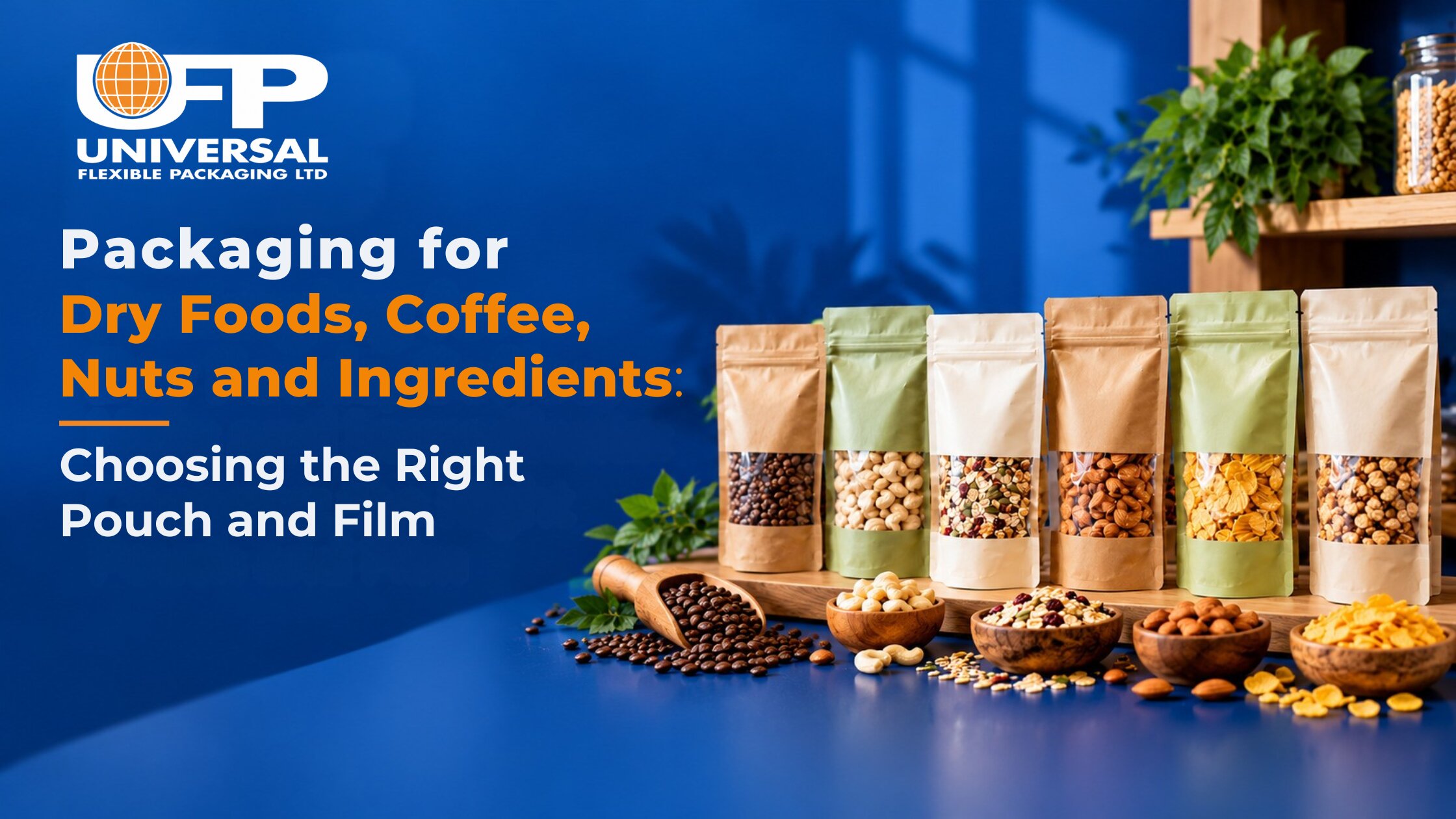
Freshly roasted coffee releases carbon dioxide after packing, nuts contain oils that can oxidise, and many dry ingredients absorb moisture from the surrounding environment.
These characteristics influence the films, closures and packaging formats used to protect the products during storage and distribution.
For food brands, choosing between printed film and ready-made pouches also depends on how the product will be filled, sealed and handled.
Roasted coffee is commonly packed in high-barrier pouches that help protect its aroma and flavour from oxygen and moisture. Freshly roasted beans may also require a one-way degassing valve to release carbon dioxide after packing. Nuts benefit from suitable oxygen and moisture protection, while dry ingredients such as grains, spices and powders need packaging matched to their sensitivity to humidity and handling. Common formats include heat-sealed pouches, resealable stand-up pouches and printed films for automated packing lines. The finished material, sealing method and storage conditions determine how well the packaging protects the product.
What packaging keeps coffee, nuts and dry goods fresh?
Coffee, nuts and dry ingredients can lose quality through different changes during storage.
Coffee is sensitive to oxygen exposure, which can affect its aroma and flavour. Nuts can develop rancid flavours when their oils oxidise, while powdered ingredients may clump when they absorb moisture.
For these applications, flexible packaging needs to provide suitable protection against the conditions that cause quality deterioration.
Common packaging options include:
- High-barrier laminated pouches for oxygen-sensitive products
- Metallised films where additional protection against moisture, oxygen or light is required
- Heat-sealed flexible packs for products intended to be opened once
- Resealable pouches for products consumed over several occasions
- Printed film on rolls for compatible automated packing lines
- Sachets for individual portions of suitable dry ingredients
The finished pack also needs to maintain its integrity throughout storage and distribution.
Leaks, damaged seals or punctures can allow moisture and oxygen to enter even when the packaging film provides strong barrier protection.
What packaging is best for coffee beans and ground coffee?
Coffee packaging needs to protect the aromas and flavours developed during roasting.
Oxygen exposure can contribute to the deterioration of roasted coffee, while moisture and light can also affect its quality during storage.
High-barrier flexible laminates are commonly used because they help reduce exposure to these conditions.
The packaging also needs to account for the amount of gas the coffee may release after roasting.
Degassing valves for freshly roasted coffee
Roasted coffee releases carbon dioxide after roasting. If significant gas is released after the coffee has been sealed, pressure can build inside the packaging.
One-way degassing valves are used in some coffee packs to allow carbon dioxide to escape while limiting air entering through the valve.
The valve manages gas released after packing, while the surrounding film and seals provide the main protection against oxygen and moisture entering the pack.
Its suitability depends on the amount of gas the coffee is expected to release and the intended packing conditions.
Coffee that has already undergone sufficient degassing may have different requirements from freshly roasted beans packed soon after roasting.
Whole beans and ground coffee
Grinding coffee increases the surface area exposed to oxygen and can accelerate changes in aroma and flavour.
It also affects how quickly trapped gases are released, which is relevant when deciding whether a degassing valve is needed.
For both whole-bean and ground coffee, the packaging should provide suitable protection for the intended storage period.
Resealable closures may be useful for larger packs that consumers open repeatedly, although the protection available after opening also depends on how the coffee is stored.
Coffee brands should confirm the required barrier specification and any valve requirements with their packaging supplier.
How should nuts and dried fruit be packaged?
Nuts contain natural oils that can deteriorate through oxidation.
The rate of deterioration depends on factors including the type of nut, its oil composition, processing conditions and storage environment.
Walnuts, almonds, cashews and other nuts can therefore have different packaging requirements.
Oxygen barrier films can help reduce exposure to air during storage, while suitable moisture protection helps maintain the product's intended texture.
For nuts supplied in retail packs, brands should consider:
- Oxygen and moisture barrier performance
- The intended shelf life
- Exposure to light and heat
- Pack strength and resistance to punctures
- Protection against crushing
- The sealing process
- Whether the pack will be opened repeatedly
Some commercial packing processes use nitrogen flushing or other methods of reducing oxygen inside a sealed pack.
Where these methods are used, the packaging structure and sealing process must be suitable for maintaining the intended conditions.
Packaging for dried fruit
Dried fruit can vary considerably in moisture content and texture.
Softer products may need packaging that helps prevent excessive drying, while ingredients intended to remain dry may require greater protection against humidity.
Packaging selection should also account for the product's water activity and susceptibility to spoilage.
Water activity describes how much water is available within a food product for processes such as microbial growth and other changes during storage.
For products that are susceptible to sticking or changes in appearance, the packaging format and handling conditions also need consideration.
What packaging works for dry ingredients, grains and powders?
Dry ingredients include products such as rice, grains, seeds, herbs, spices, baking mixes and powdered food ingredients.
These products differ in particle size, bulk density, moisture sensitivity and handling characteristics.
Powders and fine ingredients
Some powdered ingredients absorb moisture from the surrounding environment, which can cause clumping or affect how easily the product flows.
Fine powders can also interfere with sealing if particles enter the seal area during filling.
The filling process and packaging format should therefore be suitable for the powder's flow and handling characteristics.
Grains, rice and seeds
For grains, rice and seeds, the strength of the packaging becomes important, particularly for larger fill weights.
The film and seals need to withstand the weight of the contents during filling, storage and distribution.
Some products may also require attention to puncture resistance, particularly where the contents have hard or irregular edges.
Herbs, spices and baking ingredients
Herbs and spices can contain volatile aroma compounds that are sensitive to storage conditions.
For these ingredients, packaging may need to limit aroma loss alongside exposure to moisture, oxygen or light.
Baking ingredients can have different moisture requirements depending on their formulation.
Packaging helps protect dry ingredients from environmental exposure during storage and distribution. Food safety also depends on the condition of the ingredients before packing, hygiene controls and appropriate storage conditions.
How do you choose between pouches and printed films?
The choice between ready-made pouches and printed films on rolls depends largely on the intended packing equipment and production process.
Ready-made pouches
Ready-made pouches are supplied in their finished shape and are subsequently filled and sealed.
They can be suitable for brands using premade pouch filling equipment or for products requiring a particular pack format.
The pouch dimensions, opening and sealing areas must accommodate the product's fill weight and handling characteristics.
Printed film on rolls
Printed film on rolls can be used with compatible form-fill-seal equipment, which forms the packaging during the filling process.
The film's width, sealing characteristics and print registration must match the machine specification.
For automated operations, the selected material also needs to run consistently through the relevant forming and sealing stages.
Brands with existing packing equipment should confirm compatibility before approving the packaging format.
Where a contract packing service is being considered, the supplier should confirm which formats and materials its machinery can accommodate.
What should dry food brands check before ordering packaging?
Before ordering custom packaging, food brands should confirm the characteristics of the product and how it will be packed.
A specification for whole coffee beans may require different details from one for powdered spices or a nut mixture.
Important information includes:
- The product type and ingredient composition
- Whether the product is sensitive to oxygen, moisture or light
- The intended shelf life and storage conditions
- Fill weight, product volume and bulk density
- The required packaging format and dimensions
- Whether a resealable closure is needed
- Any specialist features, such as a coffee degassing valve
- Compatibility with the proposed filling and sealing equipment
- Required strength during storage and transportation
- Printing, labelling and food-contact material requirements
- Expected order quantities and delivery arrangements
For nuts and mixed food products, allergen information and controls should also be considered as part of the wider production and labelling process.
Brands should confirm whether specialist features or packing processes, including gas flushing and degassing valves, are compatible with the intended equipment.
The stated shelf life should be supported by appropriate testing using the finished product, packaging and expected storage conditions.
How does UFP support dry food packaging projects?
Universal Flexible Packaging (UFP) supplies flexible packaging materials and printing services for food manufacturers, including businesses producing suitable dry and ambient products.
The company provides printed films on rolls, stand-up pouches and barrier packaging, with flexographic and rotogravure printing capabilities.
UFP also offers packaging design and technical development support, allowing customers to discuss material selection, pack dimensions and production requirements.
Its contract packing operation specialises in suitable low-risk, ambient, free-flowing products using vertical form-fill-seal equipment or ready-made pouches.
For dry food brands, UFP can review the product's fill weight, flow characteristics and intended packaging format to establish whether it suits the available packing operation.
Specialist features or packing processes, including coffee degassing valves or gas flushing, would need separate confirmation.
The company also provides storage and delivery services from its Leicester operation.
Looking for flexible packaging for coffee, nuts or dry food ingredients?
Speak to the UFP team about suitable pouches, printed films, material specifications and production requirements for your product.