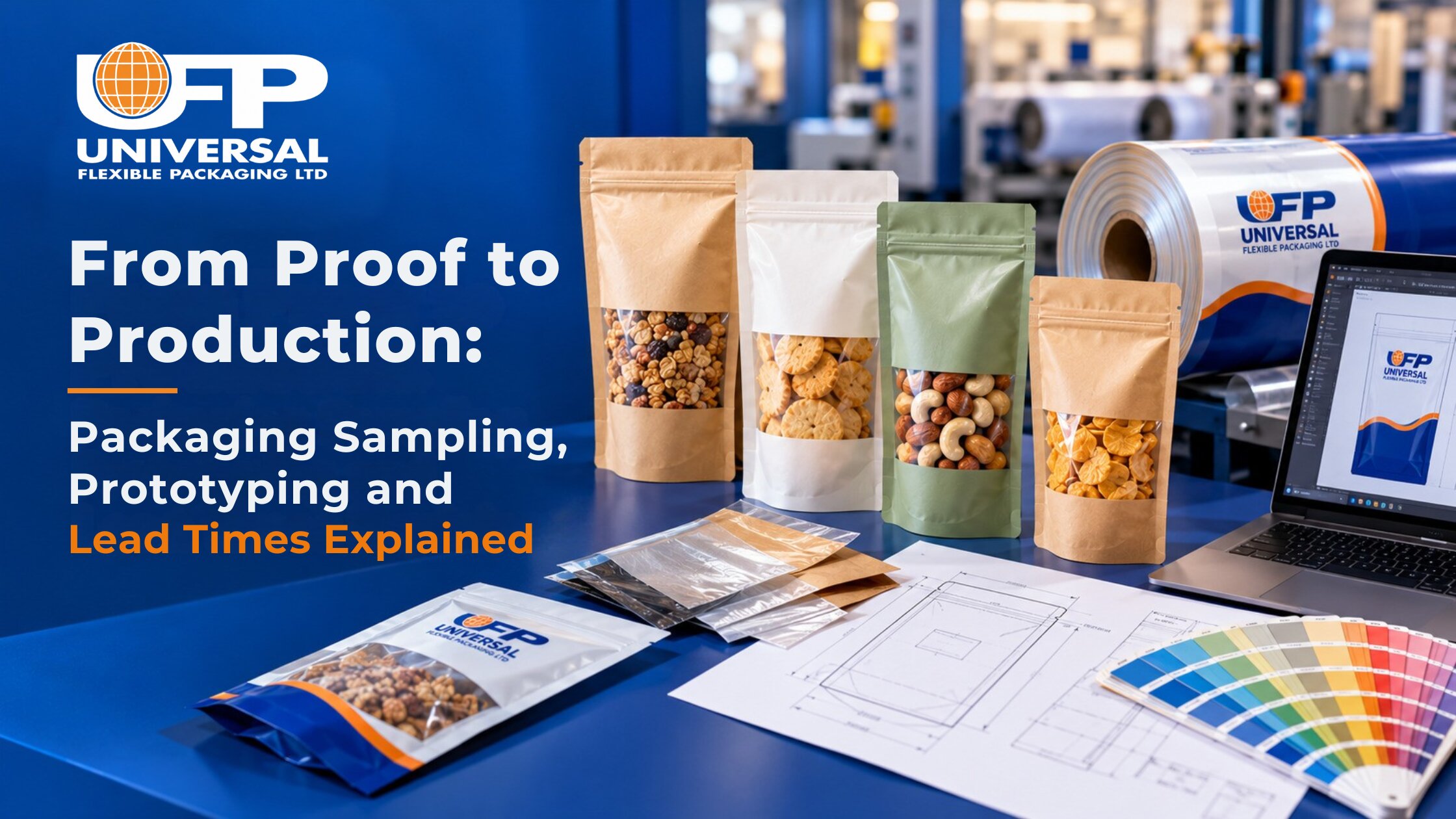
Approving the artwork for custom packaging is one stage in the process of getting the finished packs ready for production. Depending on the specification, the project can also require material preparation, sampling, printing and conversion before packaging is ready for delivery.
For food brands preparing a product launch, the time between approving a design and receiving finished packaging needs to be included in the production schedule.
Custom packaging lead times depend on the packaging specification, artwork approval, material availability, production requirements and delivery arrangements. A new packaging project can involve design development, artwork proofs, sampling, printing, conversion and quality checks before the finished packaging is delivered. There is no fixed production time that applies to every custom packaging order. Businesses should confirm whether a supplier's quoted lead time begins when the order is placed, when artwork is approved or when the project is ready for production. For an accurate timescale, the packaging supplier needs to understand the finished format, materials, quantities and required delivery date.
How long does it take to get custom packaging made?
The time required to produce custom packaging varies according to the complexity of the project and the preparation needed before production.
A repeat order using an existing approved specification can follow a different schedule from a completely new packaging design.
New projects can require additional time to confirm the packaging dimensions, material structure, artwork and printing requirements.
The overall process can include:
- Confirming the product and packaging specification
- Preparing and reviewing artwork
- Producing or reviewing samples where required
- Approving the final design and materials
- Preparing printing plates or cylinders where applicable
- Scheduling and completing production
- Carrying out quality checks
- Arranging delivery
When receiving a packaging quotation, businesses should confirm which stage starts the quoted lead time. Some schedules begin after artwork approval, while others depend on material availability, order acceptance or completion of technical approvals.
It is also worth distinguishing between the manufacturing lead time and the total time from the initial enquiry to receiving the finished packaging.
What happens before custom packaging goes into production?
Before production begins, the packaging supplier needs an agreed specification for the finished pack.
This includes confirming the packaging format, dimensions, material requirements and intended production process.
For food brands, the specification can also include barrier performance, sealing requirements and compatibility with the equipment used to fill the product.
Important details to establish include:
- The product being packaged
- The required packaging format
- Pack dimensions and fill quantity
- Material structure and barrier properties
- Printing and artwork requirements
- Number of product designs or SKUs
- Expected order quantities
- Required delivery date
Once these details have been established, the project can move through the relevant artwork and technical approval stages.
Some projects require physical samples to assess the packaging format or material before proceeding with full production.
What is the difference between a packaging proof and a prototype?
Packaging proofs, prototypes and production samples can be used to review different aspects of a packaging project before full production.
Artwork proofs
An artwork proof allows the customer to review the printed design, including text, graphics, colours and positioning.
Digital proofs can help identify layout issues before printing begins.
However, a digital proof does not necessarily reproduce the exact colour, texture or appearance of the finished printed material.
Structural prototypes
A structural prototype can be used to assess the proposed packaging dimensions, shape and features.
For example, a stand-up pouch prototype can help a brand review the pack size, gusset arrangement and position of features such as a resealable zip.
The prototype may be produced using materials or methods that differ from the intended commercial packaging.
Production-representative samples
A production-representative sample can provide a closer indication of the intended materials, printing and finish, depending on how it has been manufactured.
These samples can help businesses review aspects of the proposed packaging before committing to a full production run.
The customer should confirm what each sample is intended to demonstrate and which characteristics have been reproduced.
A physical sample does not automatically confirm sealing performance, shelf life or suitability for commercial production.
Where these factors are important, additional technical evaluation or production trials can be required.
The type of proof or sample available should be discussed with the packaging supplier.
How do artwork approvals affect packaging lead times?
Artwork approval is an important stage in preparing custom printed packaging for production.
The final design needs to match the agreed packaging dimensions and the technical requirements of the printing process.
Once artwork has been approved, the supplier can proceed with the relevant printing preparation, which can include producing printing plates or engraved cylinders.
Changes made after this stage can require additional preparation, new tooling or revised production arrangements.
For a product range containing several SKUs, each design needs to be approved before the relevant printing work can proceed.
Businesses should establish who is responsible for final artwork approval and ensure the agreed files are available when required.
The timing of these approvals can determine when production preparation begins and whether the order remains on schedule.
What factors can affect custom packaging production times?
Several factors can influence the time required to manufacture and deliver custom flexible packaging.
These include the materials selected, printing requirements, packaging format and production quantities.
Packaging materials
Some projects require specific film structures, barrier materials or finishes. Material availability and preparation can influence the production schedule.
Printing requirements
Flexographic and rotogravure printing involve different preparation processes, including printing plates or engraved cylinders.
The time required depends on the artwork, printing specification and production arrangements.
Lamination and curing
Where a packaging structure uses laminated films, the layers need to be bonded together before the material can move through the remaining production stages.
Some adhesive systems require a curing period before further processing, which needs to be included in the production schedule.
Packaging format
Printed film on rolls and ready-made pouches involve different manufacturing requirements.
Pouches can require additional conversion processes to create the finished format and incorporate relevant features.
Order quantities
The quantity ordered and the number of individual designs can affect production scheduling.
A project containing several SKUs can require additional coordination during artwork preparation and production.
Production availability
The supplier's current production schedule and equipment availability influence when an order can be completed.
Delivery requirements
Transport arrangements and the delivery destination need to be considered alongside the manufacturing schedule.
How can businesses plan packaging orders around launch dates?
Food brands preparing for a product launch should establish when the finished packaging needs to be available for filling and production.
This date provides a starting point for planning the packaging project.
Working backwards from the required delivery date allows businesses to account for artwork preparation, approvals, production and transport.
Important steps include:
- Confirming the date packaging is required
- Establishing the final packaging specification
- Agreeing artwork and approval responsibilities
- Allowing time for samples or trials where required
- Confirming material availability
- Understanding when the production lead time begins
- Allowing sufficient time for delivery
When discussing timescales with a packaging supplier, businesses should ask:
- What is the expected production lead time for the agreed packaging specification?
- Which approval or order milestone starts that timeframe?
- Does the quoted lead time include sampling, printing preparation, production, quality checks and delivery?
These questions help establish what is included in the production schedule and which stages need to be completed before the finished packaging is available.
For repeat orders, maintaining approved artwork and consistent packaging specifications can reduce the amount of preparation required before production.
Businesses should also review how changes to materials, artwork or order quantities could affect an agreed delivery date.
How does UFP support custom packaging projects?
Universal Flexible Packaging (UFP) provides flexible packaging design, printing and contract packing services for food and non-food brands.
The company supplies printed films on rolls, stand-up pouches and other flexible packaging formats, with flexographic and rotogravure printing capabilities in up to ten colours.
UFP also provides technical development support, helping customers establish packaging specifications around their products and intended production processes.
For businesses planning a new packaging project, the initial brief can cover material selection, packaging format, printing requirements and expected production volumes.
Alongside packaging supply, UFP provides contract packing, storage and delivery services from its Leicester operation.
Planning a custom packaging project?
Speak to the UFP team about your packaging specifications, production requirements and expected delivery timescales.