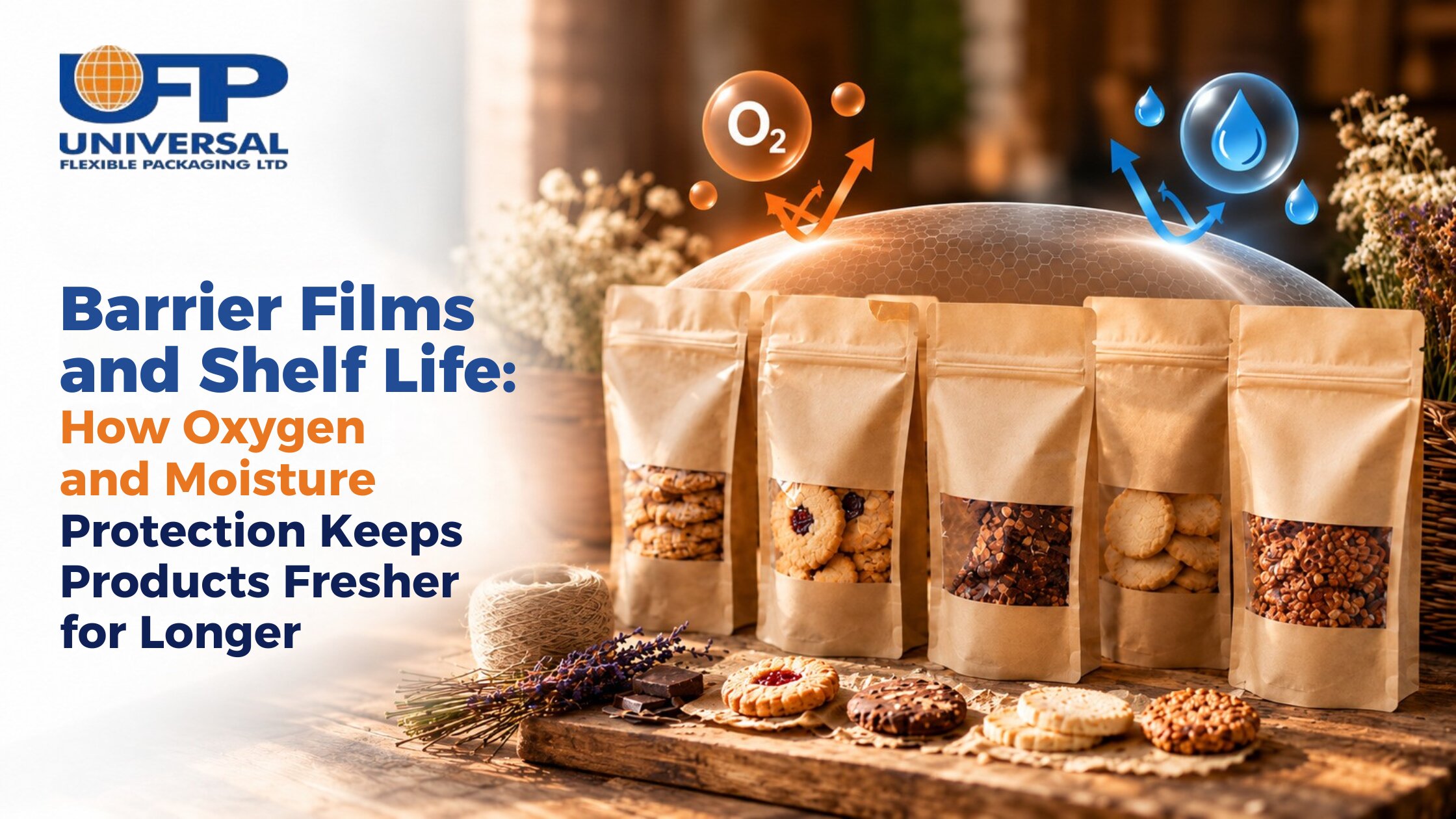
The shelf life of a packaged snack depends partly on how well its packaging protects the product from oxygen and moisture. Exposure to these elements can affect flavour, texture and overall product quality during storage.
Barrier films are designed to control the movement of oxygen, water vapour and other substances through flexible packaging. The level of protection required depends on the product and how long it needs to maintain its quality.
High-barrier flexible packaging can help maintain snack quality by reducing oxygen and moisture transmission. The level of protection needed depends on how the product deteriorates, its intended shelf life and the conditions in which it will be stored. Packaging structures using metallised films, aluminium foil or specialist barrier coatings can provide additional protection, depending on their construction and performance. There is no single packaging material that provides the longest shelf life for every snack. The appropriate barrier level depends on the product, its sensitivity to oxygen and moisture, the sealing process and the conditions in which it will be stored. The intended shelf life should be confirmed through testing of the finished packaging with the actual product.
What packaging gives snacks the longest shelf life?
Snacks that are sensitive to oxygen, moisture or light can benefit from high-barrier packaging such as metallised films, aluminium foil laminates or specialist barrier structures.
For example, crisps and other dry snacks can lose their crispness when they absorb moisture. Products containing fats and oils can also experience oxidation, which can lead to changes in flavour and aroma.
Packaging materials used for these applications can include:
- Metallised flexible films
- Aluminium foil laminates
- Specialist oxygen barrier films
- Moisture-resistant flexible films
- Multi-layer laminates combining different barrier properties
Each structure provides different levels of protection depending on the materials used and the finished packaging specification.
A snack that is particularly sensitive to oxidation can require a stronger oxygen barrier, while another product can be more sensitive to changes in moisture.
The barrier material should be selected around the product's characteristics and the conditions it will experience during storage and distribution.
How does oxygen affect the shelf life of packaged snacks?
Oxygen can cause changes in food quality through oxidation.
For snack products containing fats and oils, oxidation can contribute to rancidity, affecting flavour and aroma. This can become particularly relevant when products need to remain on shelves for extended periods.
Oxygen exposure can also affect certain ingredients, colours and other sensitive components.
Packaging designed to limit oxygen transmission can help slow these changes by reducing the amount of oxygen entering the pack during storage.
However, oxygen can also be present inside the packaging when the product is first sealed.
Some snack packaging processes use gas flushing, including nitrogen, to reduce the amount of oxygen remaining inside the finished pack. The effectiveness of this approach depends on the product, packing process and seal integrity.
For food brands, oxygen protection should be considered alongside the conditions inside the pack and the intended shelf life.
Why is moisture protection important in snack packaging?
Moisture can affect the texture, appearance and stability of packaged food products.
For dry snacks such as crisps, crackers and certain baked products, absorbing moisture can cause a loss of crispness and changes in texture.
Other products can require packaging that limits moisture loss to maintain their intended characteristics.
Moisture barrier films are designed to reduce the movement of water vapour through the packaging material.
The required level of protection depends on several factors, including:
- The moisture sensitivity of the product
- The intended shelf life
- Storage temperature and humidity
- The packaging material and thickness
- The sealing performance of the finished pack
A suitable moisture barrier can help maintain product quality during storage, particularly where products are exposed to changing environmental conditions.
The packaging also needs to retain its integrity throughout handling and transportation.
What types of barrier films are used for food packaging?
Food packaging can use different barrier materials depending on the protection required.
Some structures combine several layers to provide mechanical strength, sealing performance and protection against oxygen or moisture.
Common barrier packaging options include:
Metallised films
Metallised films use a thin metallic coating, usually aluminium, applied to a plastic film.
These materials can improve protection against oxygen, moisture and light, depending on the base film, coating quality and completed structure.
Aluminium foil laminates
Aluminium foil provides very strong resistance to oxygen, moisture and light when incorporated into a suitable laminate.
Barrier performance can be affected by flex cracking, damage or defects in the finished structure, making pack integrity an important consideration.
Specialist barrier films and coatings
Certain flexible packaging materials use specialist layers or coatings to reduce oxygen transmission.
These can be selected where a product requires additional protection while maintaining the properties needed for printing, sealing and production.
The choice of barrier material depends on the product, packaging format and intended application.
How is the barrier performance of packaging measured?
Barrier performance can be evaluated by measuring how quickly oxygen and water vapour pass through a packaging material.
Two common measurements are Oxygen Transmission Rate (OTR) and Water Vapour Transmission Rate (WVTR).
Oxygen Transmission Rate (OTR)
OTR measures the amount of oxygen that passes through a packaging material over a specified area and period under defined test conditions.
A lower OTR generally indicates stronger resistance to oxygen transmission when results are compared under the same conditions.
Water Vapour Transmission Rate (WVTR)
WVTR measures the amount of water vapour passing through a material over a specified area and period.
A lower WVTR generally indicates stronger moisture barrier performance under comparable test conditions.
OTR and WVTR results should be compared using equivalent test conditions, including temperature and humidity, as these factors can influence measured barrier performance.
Both measurements can help businesses compare packaging materials when developing a suitable specification.
However, laboratory measurements of individual films do not establish the shelf life of a finished food product.
The completed pack, its seals, the product itself and the intended storage conditions also need to be considered.
What else affects the shelf life of packaged snacks?
The barrier properties of a packaging film are one part of maintaining product quality during storage.
The finished packaging also needs to perform consistently throughout filling, sealing, transportation and retail handling.
Important considerations include:
- The quality and condition of the product before packing
- Oxygen remaining inside the sealed pack
- Seal integrity and resistance to leaks
- Damage to the packaging during handling
- Storage temperature and humidity
- Exposure to light
- The intended shelf life and product characteristics
Poor sealing can allow oxygen or moisture to enter a pack even when the packaging material provides strong barrier protection.
Similarly, damage during transportation can affect the integrity of the finished package.
Food brands should assess the complete packaging system and carry out appropriate shelf-life testing using the intended product and packaging format.
This helps establish whether the chosen materials and packing process can maintain product quality for the required period.
How does UFP support food brands with barrier packaging?
Universal Flexible Packaging (UFP) supplies flexible packaging solutions for food and snack products, including printed films, pouches and high-barrier laminates.
The company provides packaging materials designed to offer protection against moisture, oxygen and UV exposure.
UFP works with customers to understand their product requirements and develop suitable packaging specifications, taking account of barrier performance, packaging format and production needs.
Its capabilities include printed films on rolls, stand-up pouches, flexographic and rotogravure printing, and contract packing.
For food brands reviewing shelf-life requirements, UFP provides technical development support alongside storage and delivery services from its Leicester operation.
Looking for barrier packaging suited to your food or snack product?
Speak to the UFP team about flexible packaging materials, barrier performance and production options for your product.