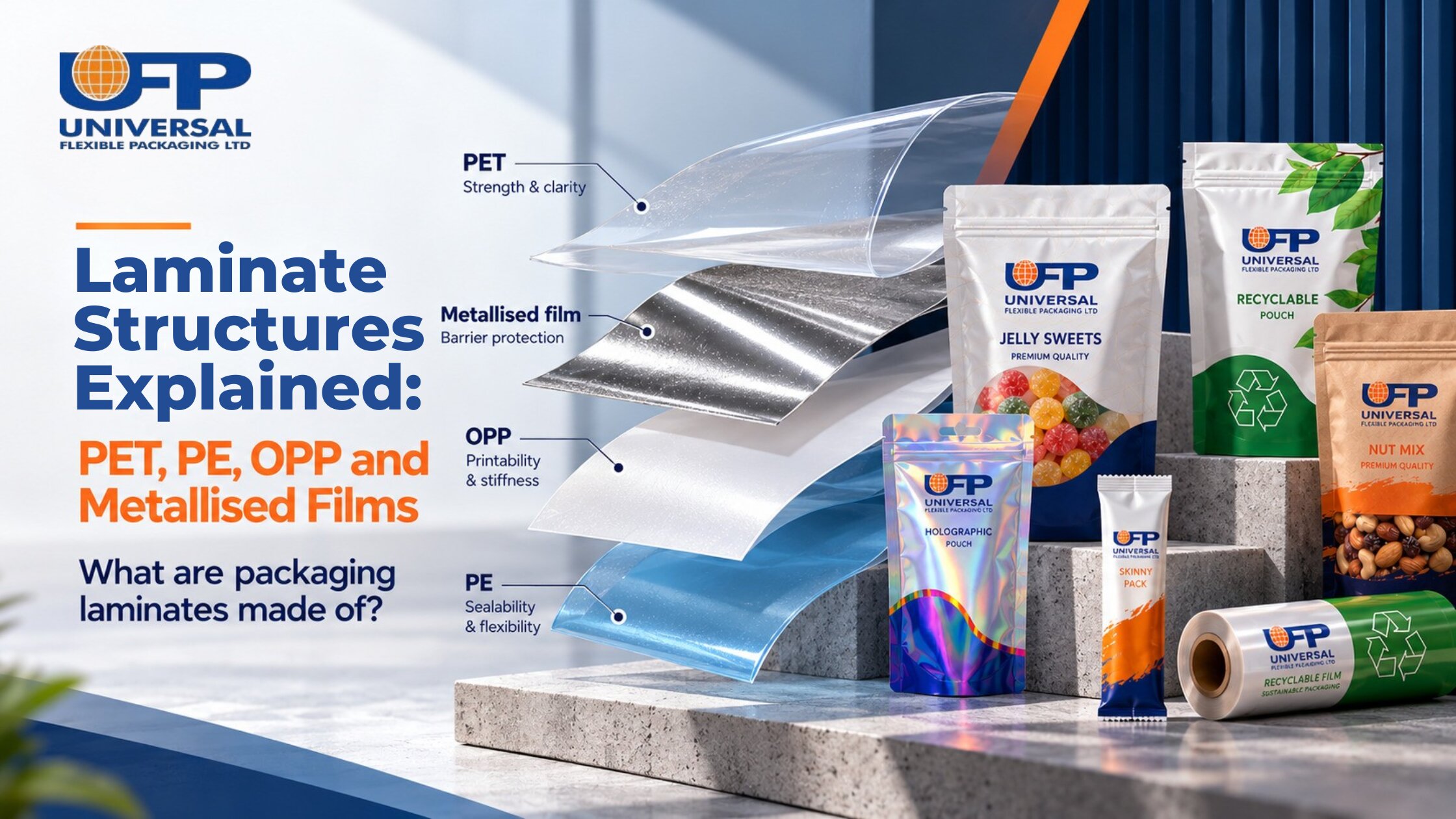
A flexible packaging laminate combines different film layers to provide the strength, sealing performance and barrier protection required for a product. The materials selected determine how the finished packaging performs during production, storage and handling.
Many food and consumer products use laminated packaging, where two or more layers of film are bonded together to create a structure with specific properties.
Materials such as PET, PE, OPP and metallised films are commonly used in these structures. Each contributes different characteristics, including printability, sealing performance, strength and protection against moisture, oxygen or light.
Packaging laminates are made by bonding two or more layers of flexible material together to create a combined packaging structure. Common materials include polyethylene terephthalate (PET), polyethylene (PE), oriented polypropylene (OPP) and metallised films. PET is commonly used for strength and printability, PE for flexibility and heat sealing, and OPP for clarity, stiffness and moisture resistance. Metallised films can provide additional protection against light, oxygen and moisture, depending on the base film, coating quality and finished laminate. The appropriate structure depends on the product, required barrier performance, packaging format and production process.
What are packaging laminates made of?
Flexible packaging laminates combine different films to provide the properties needed for a particular product.
Individual materials have different characteristics, so manufacturers can bond layers together to produce a structure suited to the intended application.
The films can be joined using adhesive lamination or extrusion lamination, depending on the materials and the packaging structure being produced.
A laminate can include an outer layer for printing and strength, an intermediate layer for barrier protection and an inner layer that allows the packaging to be heat sealed.
Common materials used in laminate structures include:
- PET (polyethylene terephthalate)
- PE (polyethylene)
- OPP (oriented polypropylene)
- Metallised PET or OPP films
- Other specialist barrier materials where required
Some laminates use two layers, while others contain three or more depending on the packaging specification.
For example, a PET/PE laminate combines an outer PET film with a PE layer commonly used for heat sealing.
More complex structures can incorporate metallised films where additional barrier protection is required.
The completed laminate must perform consistently during filling, sealing, storage and transportation.
What is PET used for in flexible packaging?
Polyethylene terephthalate (PET) is a polyester film used in flexible packaging because of its strength, dimensional stability and printing properties.
PET is commonly used as an outer layer in laminated packaging structures.
Its properties make it suitable for printed flexible packaging that needs to maintain its appearance throughout production and handling.
PET can provide:
- Good mechanical strength
- Dimensional stability during printing
- Resistance to stretching under normal processing conditions
- A suitable surface for high-quality printing
- Heat resistance within an appropriately designed laminate
PET also provides some resistance to oxygen transmission, although higher barrier requirements can require additional materials or coatings.
Within a laminate structure, PET can be combined with PE or other materials to provide the required sealing and protection properties.
What role does PE play in laminate structures?
Polyethylene (PE) is widely used in flexible packaging because of its flexibility, toughness and heat-sealing properties.
In many laminate structures, PE forms the inner layer of the packaging.
This layer allows the pack to be sealed during the filling process, helping maintain the integrity of the finished packaging.
PE can provide:
- Heat-sealing performance
- Flexibility during handling
- Resistance to moisture transmission
- Toughness and puncture resistance, depending on the grade
- A suitable product-contact layer where the material meets the relevant requirements
Different grades of PE are available, with properties selected around the needs of the packaging application.
The thickness and composition of the PE layer can influence sealing performance and how the finished pack behaves during production.
For food products, the material must also meet applicable food contact requirements.
PE is commonly combined with other materials where additional printability, stiffness or barrier performance is required.
What is OPP film and where is it used?
Oriented polypropylene (OPP) is a polypropylene film that has been stretched during manufacturing to improve its physical properties.
Biaxially oriented polypropylene (BOPP) is stretched in both the machine and transverse directions and is widely used in flexible packaging.
OPP films are used across food and consumer packaging applications, particularly where clarity, stiffness and moisture resistance are important.
Their properties can include:
- Good optical clarity
- Gloss and surface appearance
- Dimensional stability
- Moisture resistance
- Suitability for printing
- Compatibility with different packaging structures
OPP can be used as an outer layer in laminated packaging or combined with other materials to provide additional functionality.
It is used in packaging applications including snacks, confectionery and other dry food products.
Some grades are designed for heat sealing, while others require a separate sealing layer.
The grade selected needs to match the finished pack format and the sealing process being used.
What are metallised films used for in packaging?
Metallised films are flexible plastic films coated with a very thin layer of metal, usually aluminium.
The coating is applied to a film such as PET or OPP to improve its barrier properties.
Metallised films can improve protection against oxygen, moisture and light, although the level of protection depends on the base film, coating quality and completed laminate structure.
Their properties can include:
- Improved protection against light
- Reduced oxygen transmission
- Reduced moisture transmission
- A reflective metallic appearance
- Compatibility with laminated flexible packaging structures
Metallised films are commonly used in packaging for snacks, confectionery, coffee and other products requiring additional barrier protection.
They differ from aluminium foil laminates because the metal is applied as a thin coating rather than incorporated as a separate foil layer.
For food brands, the required barrier level should be established around the product's sensitivity to moisture, oxygen and light.
How do you choose the right laminate structure?
Choosing a laminate structure begins with understanding the product and the conditions the packaging needs to withstand.
A dry snack product can have different packaging requirements from a product that is sensitive to oxygen or requires greater protection during handling.
Businesses should consider:
- The type of product being packaged
- The required protection against oxygen, moisture and light
- The desired shelf life
- Pack dimensions and format
- Printing requirements
- Heat-sealing performance
- Compatibility with packing equipment
- Storage and transportation conditions
- Recyclability and material considerations
The combination of materials affects how the packaging performs throughout its intended use.
A structure containing PET and PE, for example, brings together materials with different printing, mechanical and sealing properties.
Where higher barrier performance is required, additional layers, coatings or metallised films can be considered.
The complete laminate should be assessed against the product and production requirements before the final specification is approved.
Recyclability also needs to be considered at the level of the finished structure, as combining different materials can affect compatibility with available recycling systems.
How does UFP support flexible packaging requirements?
Universal Flexible Packaging (UFP) supplies flexible packaging solutions for food and non-food products, including printed films, pouches and barrier packaging.
The company provides packaging design support, material specification guidance, printing and contract packing services.
UFP supplies high-specification barrier laminates designed to protect products against moisture, oxygen and UV exposure.
Its printing capabilities include flexographic and rotogravure printing, alongside printed film on rolls, stand-up pouches and other flexible packaging formats.
For businesses developing a new packaging specification, UFP can help review the material requirements alongside the product, pack format and intended production process.
The company also provides contract packing, storage and delivery services from its Leicester operation, allowing customers to discuss multiple stages of their packaging project with one supplier.
Looking for flexible packaging materials suited to your product?
Speak to the UFP team about laminate structures, barrier requirements and flexible packaging options for your production needs.