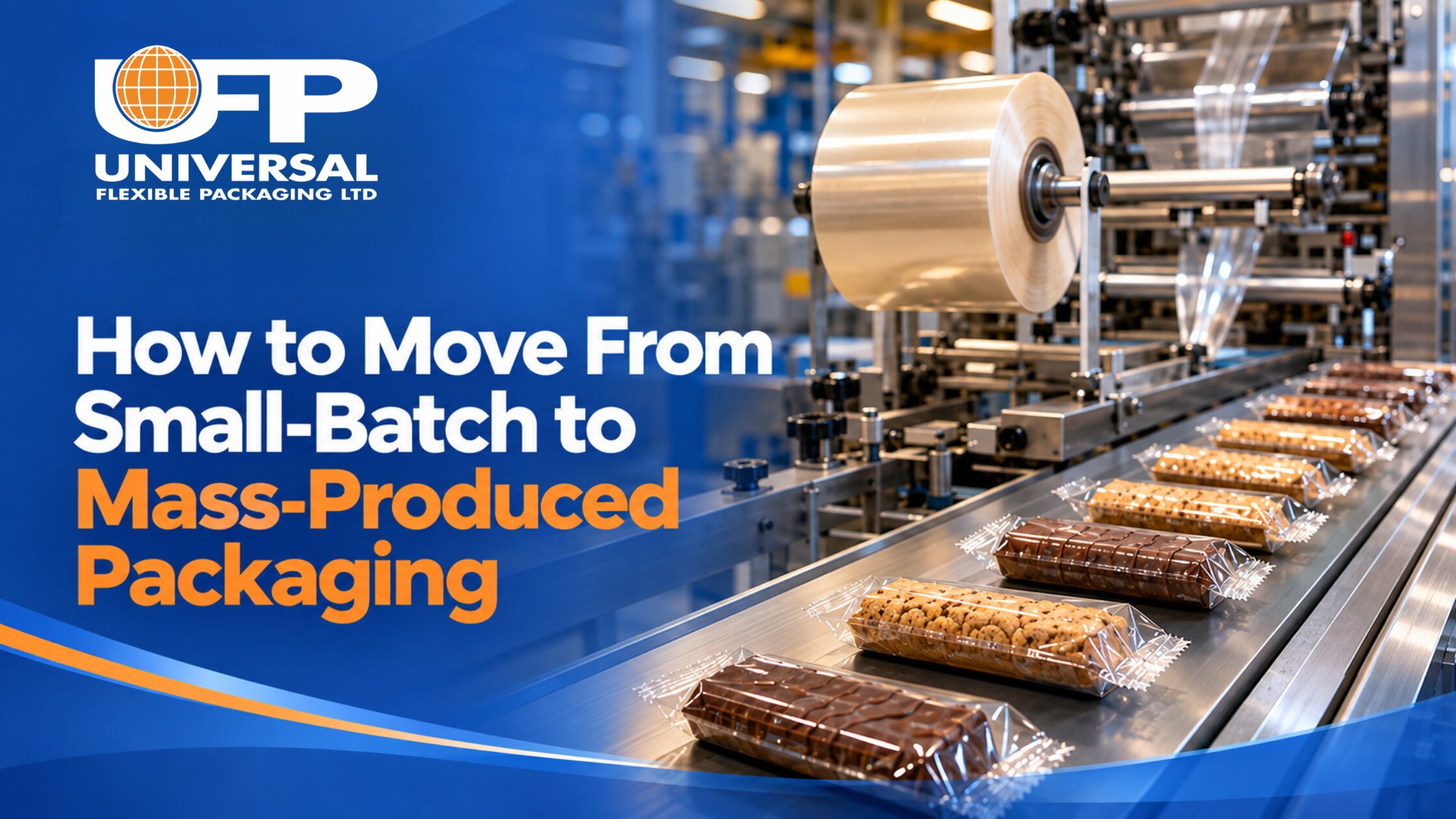
Moving from small-batch production to mass-produced packaging is a significant step for a growing food or snack brand. As demand increases, packaging needs to keep pace with larger production volumes while maintaining quality, consistency and efficiency.
The right packaging partner can help businesses prepare for increased demand, manage larger production runs and bring packaging, packing, storage and delivery together as their requirements develop.
Growing food brands moving from small-batch to mass-produced packaging should consider production capacity, packaging formats, equipment, consistency, storage and distribution before increasing volumes. A suitable packaging partner should have the production infrastructure and range of capabilities needed to support larger commercial runs as demand grows. Universal Flexible Packaging provides flexible packaging, printing, contract packing, storage and delivery from its Leicester facilities, with 20+ production lines and more than 100,000 square feet of operational space.
When should a food brand start planning for larger packaging volumes?
A food brand can begin with relatively small production runs while testing a product, building its customer base and understanding demand. As volumes increase, the packaging operation needs to develop alongside the wider business.
Planning ahead gives businesses an opportunity to consider:
- Expected production volumes
- Packaging format and specifications
- Required packing capacity
- Production equipment
- Storage requirements
- Distribution requirements
- Future increases in demand
This becomes particularly relevant when a product moves from early production into larger commercial orders. Packaging needs to remain consistent while the production process becomes capable of handling significantly greater volumes.
UFP's current operation includes 20+ production lines covering formats including flow wrap, stand-up pouches, VFFS and HFFS, supporting both shorter runs and high-volume commercial production.
What changes when packaging moves to mass production?
Moving into larger production volumes involves more than simply ordering more packaging.
Packing speed, equipment and consistency become increasingly important as production increases. The packaging also needs to perform consistently through the packing process while meeting the requirements of the finished product.
UFP has invested in production infrastructure and automated capabilities to support growing customer requirements. Its current facilities include more than 100,000 square feet of operational space across its Leicester sites and more than 20 production lines.
Candy Kittens provides an example of how packaging requirements can develop alongside a growing brand. UFP supported the business from early production runs as volumes grew from thousands of bags into the millions. As demand increased, UFP invested in a state-of-the-art MES Pack machine capable of packing up to 100 bags per minute using a multi-head weigher.
For a growing food or snack brand, having access to suitable equipment and production capabilities can help packaging keep pace as production volumes increase.
What should you look for in a packaging partner?
Production capacity is only one consideration when choosing a packaging partner.
As production grows, businesses can also face additional requirements around packaging supply, printing, contract packing, finished goods storage and distribution.
Businesses should consider:
- Contract packing capabilities
- Flexible packaging supply
- Available packaging formats
- Printing capabilities
- Production capacity
- Quality and food safety standards
- Storage facilities
- Distribution capabilities
- Ability to accommodate increasing volumes
UFP combines design, printing, packaging, storage and delivery within one operation. Its current printing capabilities include flexographic and rotogravure printing in up to 10 colours, while its packing operation covers 20+ production lines.
Its Sunningdale facility provides 2,500 pallet spaces for finished goods and incoming components, with real-time warehouse management system visibility.
Having these capabilities within one packaging operation can reduce the number of separate suppliers involved as a business grows.
How can packaging support a brand throughout its growth?
The move from small-batch production to mass-produced packaging is part of a wider change in how a food business operates.
As volumes increase, packaging needs to remain consistent while the supporting processes around printing, packing, storage and delivery become more demanding.
UFP's current model covers the journey from design and printing through to packing, storage and delivery. The business works across food, snacks and confectionery, with packaging formats ranging from flow wrap and stand-up pouches to flat-bottom bags and VFFS and HFFS formats.
For brands preparing for significant growth, choosing a packaging partner with the relevant production capabilities, infrastructure and supply chain support can make the move into larger-scale production easier to manage.
Planning to increase production for your food or snack brand?